


Normandy’s Cider Trail: A Different Side of Normandy

Like most first-time visitors to Normandy, we arrived with D-Day very much on our minds.
We spent one full day exploring the beaches, museums, and cemeteries that tell the story of June 6, 1944. We devoted another day to the magical town of Bayeux, which deserves a visit all its own and which I’ve written about in a separate blog.
But on our third day, we decided to explore a very different Normandy.
Leaving Bayeux behind, we pointed the car toward the countryside of the Pays d’Auge, the region famous for its cider, Calvados, apple orchards, pear orchards, and some of the most beautiful villages in France. With the help of ChatGPT, we programmed our GPS to connect a series of small villages while avoiding major highways whenever possible.
It proved to be one of the best decisions of the trip.
The reward was a day of winding country roads, timber-framed villages, church steeples rising above green hills, and mile after mile of orchards stretching across one of France’s most beautiful agricultural landscapes.
Why This Part of Normandy Is So Special
The Pays d’Auge has been prosperous for centuries thanks to its fertile soil and mild climate. The region became famous for dairy farming, butter, cheese, apples, pears, cider, and eventually Calvados, Normandy’s celebrated apple brandy.
Unlike many parts of Europe that modernized rapidly after World War II, much of this countryside remains remarkably unchanged. Traditional farms still operate. Villages remain compact and walkable. The landscape is protected. Even many of the houses appear much as they did generations ago.
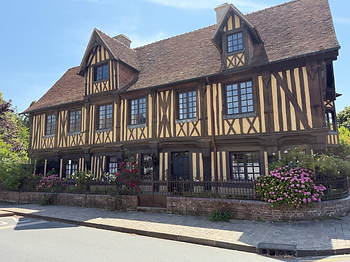
One of the region’s most distinctive features is its architecture. The famous half-timbered houses, with dark wooden beams crisscrossing white plaster walls, are everywhere. These buildings were practical rather than decorative when first constructed, using abundant local timber and clay. Today they give Normandy a character unlike anywhere else in France.
And while the region feels timeless, World War II passed directly through these fields and villages. Many communities that appear tranquil today were once headquarters, staging areas, and battlegrounds during the weeks following D-Day.
Creully: A Quiet Village with an Extraordinary Wartime Story
Our first stop was Creully.
At first glance it seems like the perfect Norman village: a lovely central square, a charming river, peaceful walking paths, and an impressive château overlooking the town.
Yet few places played a more important role in the days immediately following D-Day.
The château became a headquarters for Field Marshal Bernard Montgomery during the Battle of Normandy. From here he directed much of the Allied campaign during those critical early weeks.
Even more fascinating, the BBC established one of its first D-Day broadcasting operations inside the château’s highest tower. Journalists and radio technicians transmitted reports back to Britain from Creully, allowing listeners at home to hear news directly from liberated France. Other Allied broadcasters soon followed.
Today the BBC Radio museum helps tell this remarkable story, though the village remains largely off the radar of most visitors.
Standing in the peaceful square, watching locals go about their day, it is almost impossible to imagine the military leaders, politicians, reporters, and war correspondents who once crowded these same streets.
Through the Norman Countryside
From Creully we continued eastward, making a brief stop in Bretteville-l’Orgueilleuse before heading toward Cambremer.
This is where avoiding the highways really pays off.
The roads become narrower, the villages smaller, and the scenery increasingly beautiful. We passed orchards laden with apples and pears, grazing cattle, and farmhouses that looked as though they had been painted rather than built.
Normandy’s countryside possesses a quiet confidence. Nothing feels staged or manufactured for tourists. These are working farms and living communities that simply happen to be exceptionally beautiful.
Cambremer and a Sunday Market
Our visit happened to fall on a Sunday, and Cambremer was alive with activity.
The village is often considered one of the gateways to the famous Route du Cidre, the Cider Trail that winds through the Pays d’Auge.

A local market filled the town square with food vendors, produce stands, and families enjoying a leisurely weekend morning. What struck us most was that the crowd appeared to consist far more of locals than tourists.
That is often a good sign.
Markets remain one of the best ways to experience everyday French life, and this one felt authentic rather than performative. We wandered among the stalls, listened to conversations we only partially understood, and enjoyed watching the rhythm of village life unfold around us.
Beuvron-en-Auge: Every Bit as Lovely as Advertised
Our next destination was Beuvron-en-Auge.
Frequently listed among the most beautiful villages in France, expectations were high.
It somehow exceeded them.
The village is tiny, centered around a picturesque square lined with impeccably preserved timber-framed buildings. Flower boxes overflow from windows. Small shops occupy centuries-old structures. Every view seems worthy of a postcard.
Much of Beuvron’s survival is credited to former mayor Michel Vermughen, who championed preservation efforts at a time when many historic villages were losing their architectural heritage. Thanks to those efforts, Beuvron remains one of the finest examples of traditional Norman village design.
The artist David Hockney also spent time living in the area and was drawn, like so many others, by the extraordinary quality of light and the beauty of the surrounding countryside.
One of our favorite discoveries was lunch at La Forge. Housed in a former blacksmith’s workshop, the restaurant is run by a talented young couple. She oversees the dining room with warmth and professionalism while he works in the kitchen creating beautifully executed dishes. We learned they previously worked within the LVMH hospitality world before creating something of their own here. The meal was outstanding, the service attentive, and the setting unforgettable.
After lunch, don’t just stay in the central square. The village is small enough that wandering the lanes around its perimeter reveals some of its most charming views and quieter corners.
Château de Saint-Germain-de-Livet
Our final major stop was Château de Saint-Germain-de-Livet.
Unfortunately, a lesson for travelers: always verify opening information carefully. The website indicated the château was open, but upon arrival we learned that the interior is undergoing a multi-year restoration project and only the exterior could be visited.
Fortunately, the exterior alone is worth the trip.
The château presents a fascinating combination of architectural styles. Medieval fortifications and defensive walls coexist with later timber-framed additions that perfectly reflect the architectural traditions of Normandy.
The property was lovingly preserved by its final private owners, who ultimately donated it to the local municipality to ensure its long-term protection and public enjoyment. We spent a pleasant hour wandering the grounds, admiring the reflections in the moat and attempting to avoid three extremely friendly peacocks who seemed determined to join our tour.
Reaching the château was an adventure in itself. At one point our GPS directed us down a road so narrow that we genuinely wondered what would happen if another vehicle appeared from the opposite direction. Thankfully none did, though it made for a memorable reminder that rural France often requires a sense of humor and a willingness to trust your navigation system.
The Drinks We Missed
One regret from the day was that our leisurely pace left no time for a cider or Calvados tasting.
For future visitors, both are essential.
Normandy cider differs from many ciders found elsewhere. It is often less sweet, more complex, and produced from carefully blended varieties of apples grown specifically for cider making.
Calvados is the region’s famous apple brandy, distilled from cider and aged in oak barrels. Depending on age, it can range from bright and fruity to rich and deeply complex.
Two excellent producers that visitors might consider are Domaine Dupont near Cambremer and Père Magloire, one of the region’s best-known Calvados houses. Both offer a wonderful introduction to these iconic Norman traditions.
A Perfect Counterpoint to D-Day
What I appreciated most about this day was how perfectly it complemented our earlier exploration of Normandy’s D-Day sites.
The beaches, cemeteries, and museums are deeply moving. They should be. They remind us of the enormous sacrifices made here.
Yet the countryside tells another story.
It reminds us what all those sacrifices were ultimately for.
The orchards continue to bear fruit. Farmers continue to work the land. Markets continue to gather local communities. Children play in village squares. Life continues.
Driving through these beautiful agricultural landscapes felt quietly life-affirming. It was a reminder that even alongside the memory of war, there remains continuity, resilience, and abundance.
For us, the Normandy Cider Trail was not simply a scenic drive.
It was a celebration of everything that survived.


Comments