


St James’s: One Block Off Piccadilly, Centuries Away

One of the great joys of London is discovering how quickly you can leave the tourist trail without actually going very far.
Most visitors know the bustling stretch of Piccadilly running from the Green Park tube station, past the famous Ritz Hotel, toward Piccadilly Circus and, beyond it, the theaters of Leicester Square and the West End.
But turn off Piccadilly and walk just one block south and you enter another world.
This is St James’s, a neighborhood of quiet squares, gentlemen’s clubs, ancient shops, hidden courtyards, covered arcades and enough eccentric bits of British history to keep you wandering for hours.
Yes, St James’s Palace is here, built by Henry VIII beginning in the 1530s. Despite its enormous historical importance, it is surprisingly un-grand from the street. But the real pleasure of St James’s is not any one great monument. It is everything tucked around it.

On one side of the neighborhood is Green Park. Unlike London’s other great parks, it famously has no formal flower beds. According to a wonderfully improbable story, Queen Catherine, wife of the notoriously philandering Charles II, once caught her husband picking flowers there for another woman and ordered all the flower beds ripped out.
The Royal Parks itself repeats the story, although wisely introduces it with “It’s said.”
True or not, I choose to believe it.
At the other end is St James’s Square, surrounded by elegant townhouses and buildings that give some sense of the extraordinary wealth that once concentrated here.
A Neighborhood Built for Gentlemen
St James’s began taking its present form after Charles II returned to the throne in 1660 and London began expanding westward.
What developed here was essentially a purpose-built neighborhood for gentlemen.
And gentlemen, apparently, had needs.
They required elegant houses and apartments in which to live. They needed clubs in which to dine, drink, gamble, gossip and conduct business. They needed tailors to make their clothes, hatters to make their hats and shoemakers to make their shoes. They needed wine merchants, tobacconists, booksellers and restaurants.
St James’s provided all of it.
Remarkably, more than three centuries later, much of it is still here.
That is what makes wandering this neighborhood so extraordinary. You aren’t looking at a recreation of old London. Many of these businesses are descendants of the very establishments that served the neighborhood centuries ago.
Saucepans to Spitfires
Look closely at the Georgian and later buildings and you may notice something missing.
During World War II, Britain urgently needed metal for the war effort, and citizens were encouraged to surrender pots, pans, railings and decorative ironwork under campaigns popularly remembered by slogans such as “Saucepans into Spitfires.”
Across London, elegant iron fences and railings disappeared.
The sad and slightly absurd postscript is that much of the collected metal apparently proved unsuitable for aircraft production. Stories persist that large quantities were eventually dumped or otherwise scrapped rather than transformed into Spitfires.
So when you see an old London building whose iron railings seem oddly incomplete, you may be looking at a small scar left by the war.
Death Arrives by Train
London’s blue plaques are everywhere, but St James’s seems particularly blessed with them.
My favorite belonged to William Huskisson.

Huskisson was a prominent politician and former cabinet minister who earned an unfortunate place in history on September 15, 1830, during the ceremonial opening of the Liverpool & Manchester Railway.
At a stop along the route, passengers got out of their carriages despite having been warned not to. Huskisson approached the Duke of Wellington, apparently hoping to repair a political disagreement between them.
Then the locomotive Rocket approached.
Huskisson panicked, attempted to climb back into his carriage and was struck by the locomotive. His leg was horribly injured and he died later that day.
He is commonly remembered as the first widely reported passenger fatality of the railway age.
Imagine living long enough to witness the invention of the steam railway and then becoming famous for being killed by one.
London history can be cruel that way.
A Drink Before Going to War
At the Stafford London, another tradition tells a more poignant story.
During wartime, servicemen gathered here before departing for the front. According to hotel lore, some cut their military ties in half, leaving one piece behind with the promise that they would return to reunite it with the other half.

Today the tradition has evolved. The hotel’s famous American Bar is covered with military memorabilia, including baseball caps and other mementos left by visitors from around the world.
It is part bar, part museum and part reminder that seemingly ordinary London buildings have witnessed an extraordinary amount of history.
Bond. James Bond.
Then there is DUKES London.
Ian Fleming, creator of James Bond, was a regular visitor, and the hotel’s tiny bar remains famous for its Martinis and its association with 007.
The connection has produced plenty of mythology over the years, including the idea that Fleming’s famous “shaken, not stirred” instruction originated here.
What is certain is that DUKES takes Martinis very seriously.
Today they arrive on a trolley at your table, with the gin or vodka kept extraordinarily cold and poured directly into the glass. In fact, the famous DUKES Martini is neither shaken nor stirred.
It is also extremely strong.
There is a house limit of two per person.
Having had one, I can report that this is not an unreasonable rule.
Cigars, Clubs and Beau Brummell
Back before anyone understood what smoking did to you, a gentleman naturally required a tobacconist.
James J. Fox has been selling tobacco in St James’s since the 18th century and remains one of London’s great historic cigar merchants. Downstairs is a small museum of smoking memorabilia, including items connected with Winston Churchill and Oscar Wilde.
Smoking indoors is generally illegal in Britain, but specialist tobacconists have a narrow exemption allowing customers to sample cigars and pipe tobacco under specified conditions. So stepping inside can feel like entering another era.
Then there are the gentlemen’s clubs.
St James’s and neighboring Pall Mall contain perhaps the greatest concentration of private clubs anywhere in the world. You can walk past White’s, Boodle’s, Brooks’s, the Reform, the Carlton and others, but unless you are a member or invited guest, looking through the windows may be as close as you get.

White’s, founded in 1693, remains the most famously traditional. It still does not admit women as members.
Boodle’s has always been one of my favorites, if for no other reason than the wonderfully English fact that one of its traditional desserts is an orange fool.
And hovering over the neighborhood is the spirit of Beau Brummell, the great Regency dandy who transformed men’s fashion by championing beautifully fitted, understated clothes rather than the flamboyant outfits of the previous generation.
His statue now stands at the Jermyn Street entrance to Piccadilly Arcade, still surveying the neighborhood where a gentleman could once learn what to wear simply by observing what other gentlemen were wearing.
Some things in St James’s have not changed all that much.
Shopping Without Getting Wet
London weather also helped produce one of the neighborhood’s great pleasures: the
covered shopping arcade.
The most famous nearby is Burlington Arcade, opened in 1819, a long glass-roofed passage lined with tiny shops. The original idea was to create an elegant, sheltered environment where fashionable Londoners could shop away from the mud, traffic, weather and less genteel elements of the street.
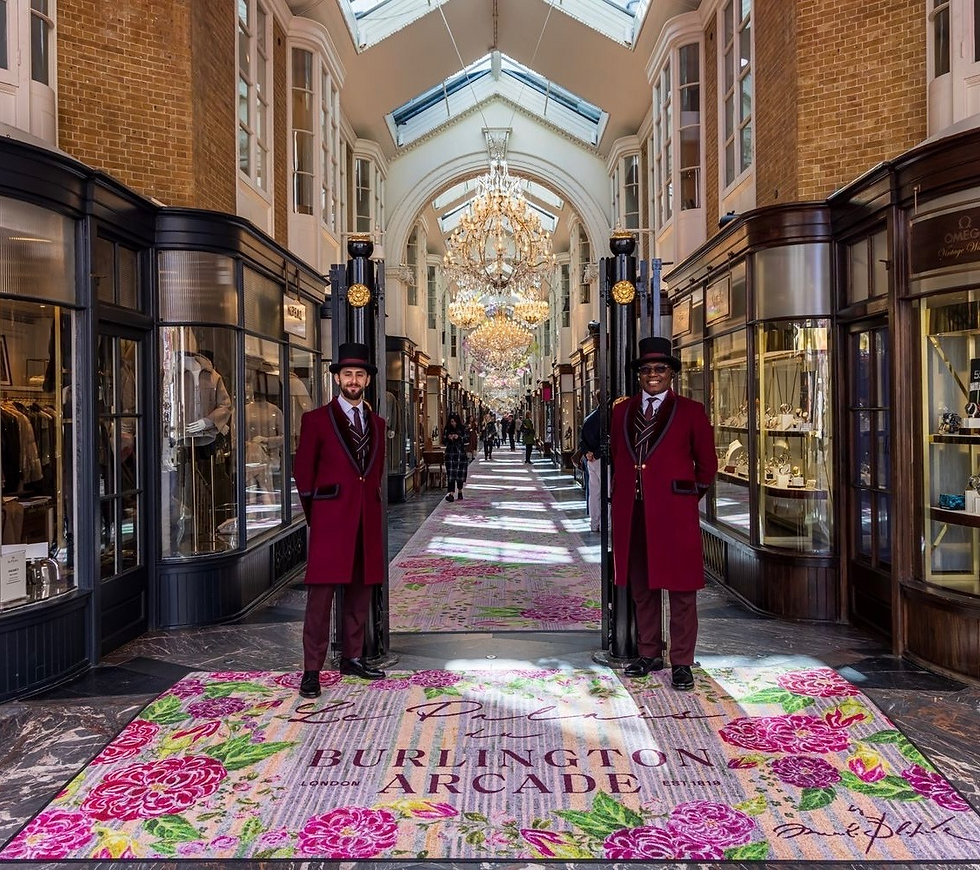
Its uniformed Beadles still patrol the arcade, maintaining standards of behavior that traditionally included prohibitions against running, singing and whistling.
Nearby Piccadilly Arcade came later, opening in 1909 between Piccadilly and Jermyn Street.
Today these arcades are filled with jewelers, watch dealers, shirtmakers, shoemakers and other luxury shops. They are worth walking through even if you have absolutely no intention of buying anything.
Although that resolve can weaken.
Fortnum & Mason
And then there is the crown jewel of St James’s shopping: Fortnum & Mason.

Fortnum’s began in 1707 with the wonderfully thrifty William Fortnum, a footman in Queen Anne’s household. The royal household insisted on fresh candles every night, leaving quantities of partially burned wax. Fortnum sold the leftovers and eventually accumulated enough money to go into business with his landlord, Hugh Mason.
From recycled royal candles grew one of the world’s great food emporiums.
As the British traveled and built an empire, Fortnum’s became famous for supplying provisions that could travel with them. Its hampers date to the 1730s, originally packed for wealthy travelers setting off from London’s coaching inns for country estates or Bath. Later, Fortnum’s supplied delicacies and provisions that traveled around the world.
In 1886, a young American named Henry Heinz arrived carrying samples of his products. Fortnum’s bought his entire stock of five cases, becoming the first British retailer to sell Heinz baked beans.
Today Fortnum’s remains wonderfully over the top: teas, biscuits, chocolates, wines, cheeses, preserves and enough beautiful packaging to convince you that almost anything would make an appropriate gift.
There are even bees living on the roof. Fortnum’s installed rooftop hives in 2008 and now produces honey from colonies around London.
An insider tip: avoid weekends and the middle of the day if possible. Go early in the morning, when you can actually wander rather than shuffle.
Another insider tip: upstairs you can arrange to have purchases packed into one of Fortnum’s famous wicker hampers and shipped to a lucky friend or family member. The hamper can later become a proper picnic basket once all the fancy contents have disappeared.
Whether by accident or brilliant marketing strategy, they have been known to offer you a glass of champagne while arranging everything.
This can be expensive.
Suddenly those clotted-cream biscuits you resisted downstairs seem essential, necessitating another trip to add them to the order.
Once, while arranging my relatively modest hamper, I sat beside a Middle Eastern couple filling a basket roughly the size of a steamer trunk.
My little hamper suddenly looked rather pathetic.
Shoes, Hats and Books
Within a few minutes’ walk are three more institutions that help explain St James’s.
John Lobb has been making bespoke shoes in London since the 19th century, creating footwear by hand for generations of aristocrats, royalty and anyone else prepared to pay for shoes intended to last decades rather than seasons.
Lock & Co. Hatters dates to 1676 and claims to be the world’s oldest hat shop. Its customers have included everyone from Admiral Lord Nelson to Winston Churchill.
And next door to Fortnum’s is Hatchards, founded in 1797 and London’s oldest surviving bookseller. Creaking floors, dark wooden shelves and books stacked everywhere make it exactly what you hope an old English bookstore will be.
You could spend a morning in these four shops alone.
A Gentleman Must Occasionally Repent
With all this drinking, smoking, gambling, shopping and clubbing, even a St James’s gentleman presumably required somewhere to repent.
Fortunately, there is St James’s Church.
Designed by Sir Christopher Wren and consecrated in 1684, the church came shortly after Wren’s enormous commission following the Great Fire of London. His office was responsible for rebuilding 51 City churches as well as St Paul’s Cathedral.
But St James’s was different.
The Great Fire had not destroyed a church here. This was a new neighborhood, and Wren was given a new site on which to design a church. The result is considered one of the clearest surviving expressions of what he wanted an intimate London parish church to be.
Today it remains one of my favorite little refuges in London.
Like many London churches, St James’s hosts lunchtime and early evening concerts, often featuring a small instrumental ensemble or vocalist.
One of my great pleasures is to buy a sandwich at Pret across frantic Piccadilly, carry it into the church courtyard and eat beneath the trees. The traffic suddenly seems a world away.
Then I wander inside, hat off, sit down and listen to the music.
Free or inexpensive. No reservation. No great planning.
Just London.
A King’s Ginger
Before leaving St James’s, stop at Berry Bros. & Rudd.

The company has been selling wine and spirits from the same extraordinary premises at No. 3 St James’s Street since 1698. Walking through the door feels more like entering an old private house than a wine shop.
Among its creations is The King’s Ginger, developed in the early 20th century for King Edward VII. The king was fond of driving his new automobile in almost any weather, and his physician reportedly asked Berry Bros. to concoct something warming and restorative for His Majesty.
The result was a fiery ginger liqueur.
If they are offering samples, do not pass one up.
And Finally, Texas
Just when you think St James’s cannot possibly produce another historical surprise, walk beside Berry Bros. & Rudd and look for a tiny plaque in Pickering Place.

For a brief period in the 1840s, before Texas joined the United States, the independent Republic of Texas maintained a legation here in London.
Texas was, quite literally, a foreign country with diplomatic representation in St James’s.
The location made perfect sense. St James’s Palace was nearby, and this was London’s diplomatic and political neighborhood.
But still.
A Texas embassy in an alleyway behind a wine merchant in London? Who knew?
And that, for me, is the great joy of St James’s.
Thousands of people hurry along Piccadilly every day, moving between Green Park and Piccadilly Circus, heading for the big sights they have been told they must see.
Turn one corner.
Slow down.
Look at the plaques. Peer into the courtyards. Walk through the arcades. Have a Martini. Buy a book. Listen to a concert. Sample some King’s Ginger.
London rewards curiosity.
Sometimes the richest history is waiting just one block off the tourist path.


Comments