


Helsinki: A Love Letter to Architecture

Helsinki is an architecture addict’s dream.
Layer upon layer of architectural styles have been packed into a remarkably compact and largely walkable city. Even more impressive is how well Helsinki has protected and restored its past while salting in striking new designs that somehow manage to feel sympathetic to what came before them.
The result is that almost every block is eye catching. You may find, as we did, that it is hard to make much progress because you are continuously stopping to stare at buildings and their details.
During our week in Helsinki, which turned out to be far too short, these were my favorites. I already have a list twice as long for our next visit, but this will give any architecture lover a running start.
And to make things a bit easier, I have listed them in the order I found them most remarkable. No doubt professional architects would quibble with my rankings, but I will leave that to their own opinions and blogs.
The Rock Church
At the top of my list is Temppeliaukio Church, universally known as the Rock Church, and unlike any church I have ever seen.

Completed in 1969 and designed by brothers Timo and Tuomo Suomalainen, the church was blasted directly into a massive outcropping of solid granite. Instead of covering up the rough rock walls, the architects made them the centerpiece of the sanctuary. Natural light pours in through a ring of skylights surrounding an enormous circular copper ceiling.
And it was that ceiling that stopped me in my tracks.
It consists of an immense coil of copper that seems to hover above the sanctuary like some sort of flying saucer. It is quite hard to describe in words, or even capture in photographs.
Somehow, floating above all that rough stone, it creates the sense of a celestial space suspended over your head.
The combination should not work. Raw rock. Copper. Glass. Concrete. Yet together they create one of the most spiritual modern spaces I have ever encountered.
Insider tip: Check the church’s concert schedule before visiting. We happened upon a free Friday noontime concert by a pianist who told us this was somewhere around his 700th performance there. Each week he invites a different musician to accompany him. Ours was a female vocalist performing a freeform version of what I can only describe as Finnish jazz scat. Odd as that sounds, inside this extraordinary space it somehow resembled what I imagine a group of angels chattering might sound like.
Finlandia Hall
As you approach the massive white Finlandia Hall overlooking Töölö Bay, you might be surprised to learn that it was designed in the 1960s and completed in 1971. It looks remarkably contemporary.
It was designed by Alvar Aalto, Finland’s most revered architect and one of the giants of 20th century modern architecture. His influence on Helsinki is almost impossible to overstate.
Finlandia Hall was part of Aalto’s much larger plan for Helsinki’s center, most of which was never built. Clad in white Carrara marble dramatically contrasted against black granite, the building was partly inspired by the palaces of Venice, with architecture, water and landscape intended to work together.
Aalto even designed the furnishings, lighting, door handles and countless interior details. It is not simply a building but what architects call a total work of art.
And as if Helsinki needed any further validation of its architectural importance, Finlandia Hall became part of a new UNESCO World Heritage Site in July 2026 honoring 13 major works by Aalto.
Insider tip: Like so many cultural institutions in Helsinki, Finlandia Hall has a charming café well worth stopping in for coffee or lunch. The food is almost as artfully presented as the building itself, and the views over Töölö Bay may find you lingering long past the time you planned to leave.
Helsinki Music Centre
Almost immediately next door to Finlandia Hall is the much newer Helsinki Music Centre, or Musiikkitalo.
We nearly gave it a miss because from the outside it seemed rather understated. That, it turns out, was intentional. Its architects wanted a building that would defer to the important landmarks surrounding it rather than compete with them.
Then you step inside.
The enormous glass-filled central space rises seven stories and is one of those interiors that makes you involuntarily inhale when you first see it. Much of the building’s considerable mass is actually buried underground, allowing the exterior to remain low while the interior unfolds dramatically around you.
At its center is the main concert hall, designed almost like a vineyard with the audience surrounding the stage. Glass walls connect portions of the hall with the surrounding foyer, bringing natural light unusually deep into a concert space.
It is architecture that reveals itself from the inside out.
Insider tip: The Music Centre presents major performances by the Helsinki Philharmonic and Finnish Radio Symphony Orchestra, but also many smaller and sometimes free concerts, including performances connected with the Sibelius Academy. They are less widely publicized and well worth investigating.
Amos Rex
Several blocks away is perhaps one of the most astounding small museums and outdoor spaces we encountered on our journey.

Amos Rex is partly housed beneath Lasipalatsi, the “Glass Palace,” a celebrated 1936 Functionalist building that was originally intended to be temporary. Rather than overwhelm this historic building with a large new museum, architects at JKMM performed something close to an architectural magic trick: they put most of the museum underground.

The galleries spread beneath the public square, while enormous sculptural concrete domes bubble up through the plaza above. Children climb them. Teenagers skateboard around them. Adults sit on them. Skylights punch through their tops, allowing daylight into the galleries below.
The roof of the museum has effectively become one of Helsinki’s most playful public spaces.
To be quite honest, we were far more taken with the building than with the contemporary art being exhibited inside. But just experiencing this underground space was easily worth the modest price of admission.
Helsinki Central Railway Station
Every guidebook will direct you to Helsinki’s Central Railway Station, and for once the guidebooks do not exaggerate.
Designed by Eliel Saarinen and opened in 1919, the station sits at a fascinating hinge point in Finnish architecture. Saarinen had emerged from the Finnish National Romantic movement, but by the time the station was completed he was moving toward a cleaner, more modern architectural language.
The building therefore manages to feel monumental, romantic and strikingly modern all at once.
Its most famous residents are the four enormous granite “Stone Men” flanking the main entrance, each holding a glowing spherical lamp. They have become unofficial mascots of Helsinki.

Our guide showed us photographs of the men being dressed to commemorate whatever was capturing Finland’s imagination at the moment. They have worn giant face masks during Covid, Finnish national hockey jerseys, bright green boleros celebrating Eurovision star Käärijä and even KISS masks when the band came to town.
During our week in Helsinki we passed through or alongside the station nearly every day, sometimes several times a day, and every single time I noticed some previously missed and mouthwatering detail.
Insider tip: Do not simply rush through to catch a train. The station contains some spectacular historic restaurant spaces. One of the grandest, amazingly, housed a Burger King for nearly ten years. The fast food restaurant left the historic hall in 2024, the space was painstakingly restored, and it has now returned to something much closer to its original purpose as a grand restaurant and gathering place. Even if only for a drink or coffee, treat yourself.
Two Libraries, 173 Years Apart
Those of you who read my travel blogs know that I am somewhat obsessed with libraries. I often make them one of my first stops in a new city because I consider a public library a pretty good litmus test of a community’s dedication to its common life.
Helsinki delivers spectacularly, with two libraries built 173 years apart.
The National Library of Finland, just off Senate Square, was designed by Carl Ludvig Engel and completed in 1845. Entering it feels like stepping into a jewel box of European Neoclassicism. The great domed central hall leads into columned reading rooms filled with galleries, books, painted ceilings and beautifully controlled natural light.
Then there is Oodi.

Completed in 2018 directly across from Finland’s Parliament, Helsinki’s new Central Library may be one of the best arguments ever made that libraries are not relics of the past but essential pieces of the future.
Its great undulating wooden façade seems to sweep people into the building. Inside are not only books but recording studios, meeting rooms, sewing machines, 3D printers, gaming areas, workspaces, a cinema and places simply to sit and be around other people.
One of my favorite architectural details is political as much as physical. Oodi’s enormous Citizens’ Balcony was deliberately placed at approximately the same level as the entrance steps of Parliament across the square. The symbolism is unmistakable: knowledge, citizens and government meet each other at the same level.
And then there are Tatu, Patu and Veera, three robots named after beloved Finnish children’s book characters. They help move boxes of books between floors.
A library with robots. What is not to love?
Insider tip: While the National Library does not have a café, Oodi has a very good one. It even serves Finland’s beloved salmon soup on certain days, making it entirely possible to spend several hours there without any compelling reason to leave.
The City of Jugend
While many of the individual buildings above are modern, much of the architectural fabric that simply delighted us dates from around the turn of the 20th century.
Helsinki calls it Jugend, the German and Nordic cousin of what we generally call Art Nouveau.

But Finnish Jugend developed its own personality. Instead of the delicate flowers and sinuous Parisian ironwork we associate with French Art Nouveau, Helsinki’s version frequently feels heavier, earthier and more fantastical. Granite, towers, rounded bays and deeply carved entrances are decorated with bears, squirrels, pinecones, owls, trolls and creatures seemingly pulled straight from Finnish mythology.
Entire neighborhoods, particularly Katajanokka, Eira and parts of Ullanlinna, contain block after block of these buildings.
Part of what makes Helsinki so remarkable is how much of this urban fabric survived. Rather than existing as isolated monuments, these buildings remain apartments, offices and shops and are simply part of everyday Helsinki.
Walking through these neighborhoods becomes something of an architectural treasure hunt. Look up. Look at the doors. Look at the carved animals hiding around windows. Look at the extraordinary entrance halls glimpsed through glass doors.
Progress becomes very slow.
Finnish National Romanticism
Closely related to Jugend, but carrying a much more political message, was Finnish National Romantic architecture.
At the turn of the 20th century Finland was still a Grand Duchy of the Russian Empire. As Russian efforts to tighten control increased, Finnish artists, writers and architects began searching for a distinctly Finnish cultural identity.
Architecture became part of that independence movement.
Buildings were created from rough Finnish granite and decorated with animals, plants, folklore and imagery from the Kalevala, Finland’s national epic. They were buildings designed to say, quite literally in stone: We are Finnish.
Among the best central Helsinki examples are the extraordinary Pohjola Insurance Building on Aleksanterinkatu, covered with bears, squirrels, pinecones and mythical creatures; the National Museum of Finland, with its medieval-looking tower and rough stone walls; the former headquarters of the Finnish Literature Society; and, bridging National Romanticism toward modernism, Saarinen’s magnificent Central Railway Station.

The Pohjola building may be my favorite. Completed in 1901, its façade looks almost as if someone asked a group of sculptors to turn a Finnish fairy tale into an office building.
Insider tip: Many Jugend buildings are private apartment houses with locked front doors. Some of the grand National Romantic commercial buildings, however, remain offices and shops. Where public access is permitted, poke your head inside. Their entrance halls can be every bit as fanciful as their exteriors.
Two Cathedrals, Two Completely Different Ideas of God
Every guidebook will also send you to the two great churches overlooking central Helsinki.
Uspenski Cathedral, consecrated in 1868, is considered the largest Orthodox church in Northern and Western Europe. Sitting dramatically on a hill above the harbor, its red brick exterior, green roofs and golden onion domes are unmistakably Russian.
Inside is an explosion of icons, gold, chandeliers and religious imagery.
Across the city, Helsinki Cathedral dominates Senate Square. The great white Lutheran church is almost its architectural opposite.
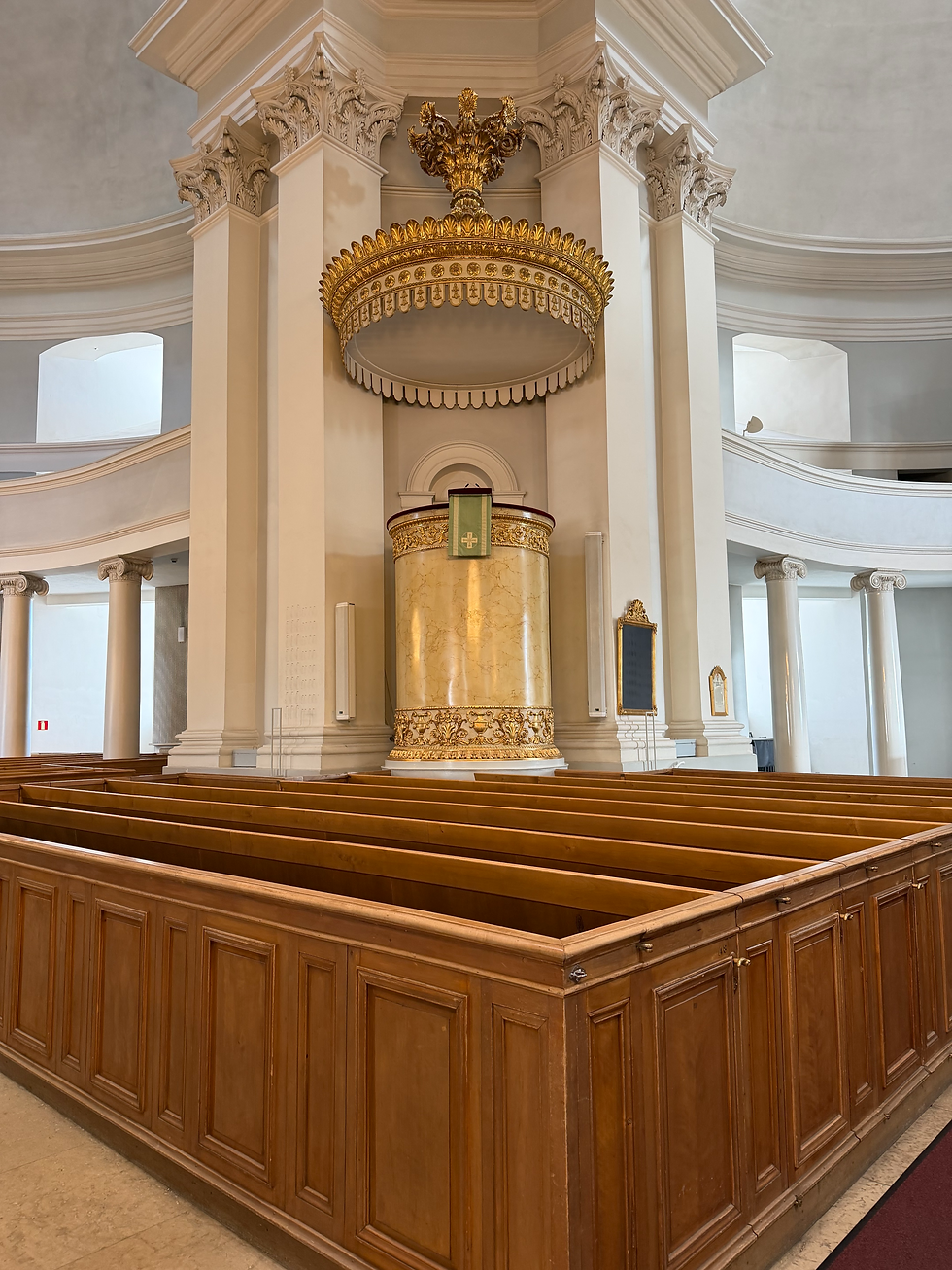
Guides and guidebooks may encourage you to pay the admission fee to see Uspenski’s ornate interior while suggesting there is less to see inside the much plainer Lutheran cathedral.
I disagree.
I found Helsinki Cathedral much more impactful and, in an unexpected way, more spiritual precisely because of its lack of ornamentation.
The interior is almost startlingly restrained, with one marvelous exception: the extraordinary sounding board floating above the pulpit. Before electronic amplification, these canopy-like structures helped project a preacher’s voice throughout a large church.
In a sanctuary almost entirely stripped of decoration, the architect allowed himself one spectacular flourish, and used it to amplify the teachings of the church.
Somehow that seems perfectly Finnish.
Following Alvar Aalto Around Helsinki
Once you begin recognizing Alvar Aalto’s work, Helsinki turns into another architectural treasure hunt.
I managed to see at least six Aalto-designed office buildings, a bookstore and even the interior of the famous Savoy Restaurant.
It is impossible to overstate his influence on 20th century architecture. Yet what surprised me most was how quietly his buildings inhabit Helsinki.
Many ordinary Helsinki residents walk past them every day without necessarily knowing they were designed by one of the most influential architects of the last century. Built largely from the 1950s through the 1970s, they fit so seamlessly into the city that many still look astonishingly fresh and contemporary.
That may ultimately be the greatest compliment you can pay an architect.
And in July 2026, UNESCO essentially agreed, placing a collection of 13 Aalto sites on its World Heritage List, including five in Helsinki.
But Helsinki’s architectural pleasures are not limited to individual buildings. Given enough time, there are entire places and experiences an architecture lover should explore.
The City Beneath the City
Underneath Helsinki is another Helsinki.
The city has approximately 5,500 civil defense shelters with space for around 900,000 people, considerably more than Helsinki’s permanent population. Many of the largest have been blasted directly into the bedrock beneath the city.
The engineering is remarkable. The reason for it is sobering.
Finland shares an 830-mile border with Russia, and preparedness here is not an abstract exercise.
What makes these underground spaces particularly fascinating is that many are not sitting empty waiting for a disaster. In ordinary times they are used for parking garages, sports facilities and other public activities. You can swim, play basketball and exercise deep beneath Helsinki in spaces that could be converted into shelters if ever required.
It is both a remarkable feat of engineering and urban design and a sad commentary on the continued threat Finns feel from their enormous neighbor to the east.
Insider tip: Specialized tours occasionally explore Helsinki underground, but you can also experience parts of this subterranean world simply by seeking out some of the sports and recreational facilities housed underground.
The Wooden Helsinki That Almost Disappeared
Central Helsinki contains little of the wooden architecture that once characterized Finnish towns.
Many visitors therefore take a day trip to picturesque Porvoo to see its famous wooden houses. Porvoo is lovely, but there is a much easier and, to my mind, more interesting alternative.
Take Helsinki’s excellent public transportation out to Puu-Vallila and Puu-Käpylä.
Puu-Vallila was developed largely as working-class housing in the early 20th century. Its colorful wooden houses, small gardens and narrow streets create an almost village-like environment remarkably close to central Helsinki. The neighborhood was once threatened with demolition but was eventually preserved and restored.
Puu-Käpylä, developed beginning in the 1920s, takes the idea further, combining the Finnish wooden-house tradition with the English Garden City movement. Low wooden houses sit among trees and gardens along quiet streets that feel worlds away from Helsinki’s monumental center.
Together the two neighborhoods reveal another side of Finnish architecture: modest, humane, domestic and intimately connected with nature.
Insider tip: I was unable to find much in the way of tours on the usual mass-market sites such as GetYourGuide or Viator. The Architecture & Design Museum Helsinki, however, offers specialized architectural walking tours of both Vallila and Puu-Käpylä, as well as other neighborhoods. For an architecture addict, their tour schedule is worth investigating before arriving.
And Finally, the Architecture of Sauna
You cannot write about Finnish architecture without writing about saunas.
Estimates vary, but Finland has somewhere around three million saunas for a population of only about 5.6 million people. In other words, there is roughly one sauna for every two Finns.
They range architecturally from tiny wooden lakeside cabins to elaborate urban bathhouses.
In Helsinki I visited two that could hardly have been more different.

Yrjönkatu Swimming Hall opened in 1928 as Finland’s first public swimming hall. Hidden almost invisibly inside a city block, it is a gorgeous example of 1920s Nordic Classicism. The 25-meter pool is surrounded by arcades, colorful tile and private curtained changing and resting cabins. Upstairs are additional saunas, including wood-fired ones, and a café.
It feels less like visiting a municipal swimming pool than slipping into an elegant European bathhouse from another era.
Then there is Allas Sea Pool, sitting directly on Helsinki harbor beside Market Square.
Completed in 2017, it is almost the opposite: contemporary, open, built largely of wood and stretched horizontally along the waterfront. Its architects designed it as a giant wooden sculpture that protects bathers from the wind while framing views of the sea and city.
You can sit in a sauna looking toward the harbor, then swim in a heated 25-meter outdoor pool or, for the braver among us, plunge into a pool filled with filtered Baltic seawater.
Ferries glide past. The Presidential Palace sits nearby. Helsinki unfolds around you.
Insider tip: Check schedules carefully. Yrjönkatu traditionally has separate days for men and women. And do not treat a Finnish sauna as something to squeeze into a 30-minute opening in your itinerary.
Make an afternoon of it.
A sauna visit here is not simply about sitting in a hot room. You swim. You sauna. You cool off. You sit. You have coffee or lunch. You sauna again. The brave plunge into cold water. Then everyone sits around some more.
Eventually you realize that saunas are not really an amenity in Finland.
They are another kind of public architecture, places designed for health, relaxation, conversation and community.
And perhaps that is what I liked most about Helsinki’s architecture generally.
For all the celebrated architects and spectacular buildings, the city rarely seems interested in architecture simply for architecture’s sake. Its best buildings are places people actually use: libraries, concert halls, train stations, swimming pools, saunas and public squares.
Helsinki does not merely preserve great architecture.
It lives in it.


Comments