


Festival d’Avignon & New Discoveries

In an earlier blog, I wrote at length about my favorite things to see and do in Avignon, one of my favorite cities in France. On a recent return visit, however, I happened to arrive during the famous Festival d’Avignon and discovered an entirely different side of the city, along with several wonderful places I had somehow missed before.
While I had certainly heard of the Festival d’Avignon, nothing prepared me for the sheer scale of it. Every July, this already beautiful medieval city transforms itself into what is arguably the world’s largest celebration of live theatre.
The festival was founded in 1947 by the French actor and director Jean Vilar, who believed great theatre should be accessible to everyone, not just the cultural elite. What began with a handful of productions performed in the magnificent Cour d’Honneur of the Palais des Papes has grown into two intertwined festivals. The official Festival d’Avignon presents internationally acclaimed productions, while the Festival Off d’Avignon has become one of the largest fringe theatre festivals anywhere in the world, with thousands of independent artists mounting their own productions.
The inevitable comparison is with the Edinburgh Festival Fringe. Edinburgh is generally considered the largest performing arts festival in the world, but Avignon is its French counterpart and every bit as important in the European theatre world. Together they occupy the top tier of international performing arts festivals. During July, Avignon hosts well over 1,500 different productions, with more than 30,000 individual performances presented in churches, courtyards, schools, theatres, gardens, cafés and temporary venues throughout the city. Attendance now exceeds 700,000 admissions during the festival, remarkable for a city whose permanent population is only about 90,000.
The city itself becomes one giant stage.
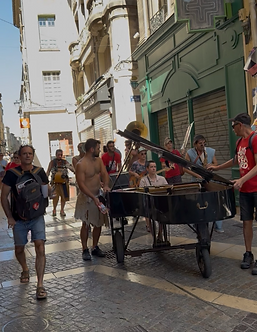
Walking through the streets, you encounter hundreds of performers every day enthusiastically handing out flyers for their shows, often dressed in wonderfully outrageous costumes. I saw one troupe of trapeze artists somehow navigating the cobblestones on stilts. Another company pulled a grand piano through the streets on wheels while a pianist happily played as they marched along. There was a group of men sporting beards, pencil skirts and impossibly high heels, while another young woman was dressed from head to toe as an enormous parrot. In the 95-degree Provençal heat, her costume must have been absolutely suffocating.
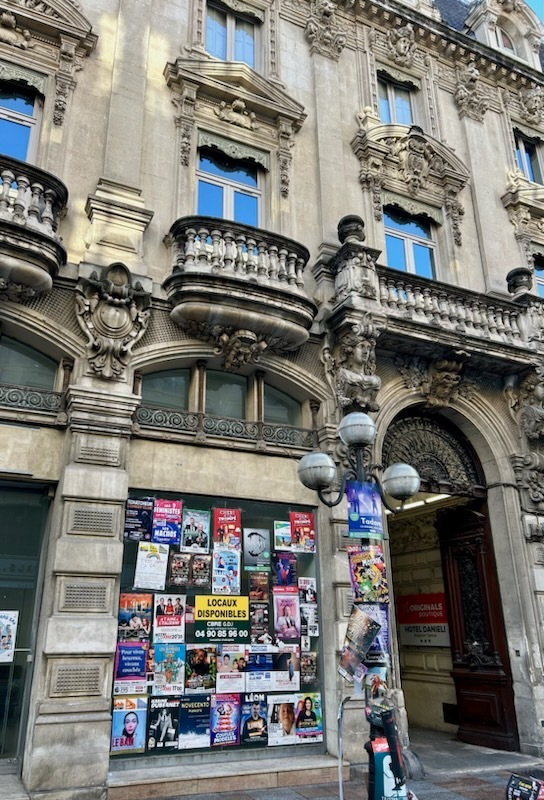
All of these colorful characters, however, were dwarfed by the seemingly endless crowds of visitors, many clutching melting gelato cones in what was largely a futile attempt to cool themselves beneath the relentless summer sun.
We attempted to book several performances but eventually surrendered to what proved to be a ticketing system that exceeded our technical talents. Even when we successfully paid online, no tickets ever appeared. Had the charge not shown up on our credit card statement, we would never have known the purchase had actually gone through. As it happened, the performance wasn’t until 9:30 that evening, and after a full day exploring the city followed by dinner accompanied by a lovely bottle of Provençal rosé, we were both fast asleep long before the curtain rose.
Sometimes travel plans simply make their own decisions.
A few practical tips if you visit during the festival:
Expect dramatically larger crowds than at any other time of year. Restaurant reservations become much more important, cafés fill quickly, and parking garages outside the medieval walls are often completely full by mid-morning. During most of the year, parking in Avignon is surprisingly manageable because so much is located outside the historic center. During the festival, however, demand easily overwhelms supply. The energy is infectious, but it does require a little more patience and planning. I have written previously about several of my favorite museums in Avignon, both large and small, but somehow I completely overlooked one of the city’s finest: Collection Lambert.
Housed in two elegant eighteenth-century hôtels particuliers, the museum exists thanks to the extraordinary generosity of the French art dealer and collector Yvon Lambert. Rather than dispersing his remarkable collection, he donated hundreds of important contemporary works to the French state, creating one of the country’s premier museums of modern and contemporary art outside Paris. The collection includes works by artists such as Cy Twombly, Anselm Kiefer, Sol LeWitt, Jean-Michel Basquiat, Christian Boltanski and many others. Even if modern art is not normally your first choice, the quality of the collection and the beautifully restored buildings make it well worth a visit.
Another delightful discovery was completely unexpected.
The city’s main public library, the Bibliothèque Ceccano, occupies the former Cardinal Ceccano Palace, a fourteenth-century residence built during the era of the Avignon Papacy. Entering the modern reception area with its circulation desk, computers and contemporary furnishings, you would never imagine what awaits upstairs.
Climb to the second floor and you suddenly find yourself in the former Great Hall, its walls decorated with some of the finest surviving medieval frescoes in Avignon. Dating from the fourteenth century, the paintings depict hunting scenes, courtly life and richly decorative motifs that have somehow survived nearly seven hundred years.
What struck me most was not simply the beauty of the frescoes but the delightful contrast. Beneath these ancient walls sat rows upon rows of bookshelves and study tables occupied almost entirely by young students wearing headphones, quietly studying or typing away on their laptops. Seven centuries separated the artwork from its modern occupants, yet somehow the room felt perfectly alive. It was one of the most charming spaces I discovered during the entire trip.
Like virtually every French city with a thriving tourist economy, Avignon offers no shortage of excellent food—a subject about which the French are justifiably proud.
I have written before about several favorites, but this visit introduced me to three new discoveries.
The first was eating at the counters inside Les Halles d’Avignon, the city’s wonderful covered food market. Most visitors come to admire the dazzling displays of fruit, vegetables, cheeses, charcuterie, seafood and pastries. Locals, however, know that some of the market’s best meals are found at the small counters tucked around the inside perimeter. Pull up a stool, order whatever looks freshest that day, and enjoy one of the most authentic lunches in the city.
A more elevated experience was lunch at La Fourchette, which I enjoyed so much that I returned a second time. Always for lunch, of course, when the menus are considerably more affordable and provide the perfect interlude during the traditional midday pause, when many shops close between approximately 12:30 and 2:00. The service was gracious, the cooking inventive without being pretentious, and on both visits I noticed that the overwhelming majority of diners were French, despite the restaurant being located only a block from the Place de l’Horloge behind the Hôtel de Ville. I always take that as an encouraging sign.
Finally, because we happened to be celebrating a seventieth birthday, we decided to indulge ourselves with lunch at the legendary La Mirande. Occupying a grand eighteenth-century mansion immediately beside the Palais des Papes, La Mirande is widely regarded as one of France’s most beautiful boutique hotels.

Once the residence of the cardinals who served the papacy, the building has been painstakingly restored with extraordinary attention to historical detail. Rich silk fabrics, period furniture, painted wall coverings and antique textiles create interiors that have appeared for decades in design magazines around the world. The hotel offers several dining experiences, including its Michelin-starred gastronomic restaurant, an elegant dining room overlooking the palace, and the famous “Table Haute,” where guests gather around the kitchen itself.
As someone who has admired photographs of its interiors for years, I had never quite felt appropriately dressed even to stop in for a drink. This trip, wearing freshly pressed linen trousers and a linen shirt, I finally walked through the front door.
Friends and family will probably conclude that I temporarily lost all economic judgment, but I also enjoyed what was quite simply the most memorable meal of my life, served in perhaps the most beautiful dining room I have ever experienced. Eight exquisite courses later, we emerged into the brilliant Provençal sunshine feeling both thoroughly spoiled and deeply grateful for a meal that will remain one of the highlights of our travels.
The following morning brought us happily back to earth.
We wandered through the neighborhood market, bought tomatoes picked the previous day, olives, a roast chicken, fresh strawberries and a little crème fraîche, then returned home to make a simple tomato and olive tart.
Far less artistic than the previous day’s lunch.
Far less expensive as well.
And every bit as satisfying.
As people in the fashion world like to say, the secret is learning to combine high and low. I suspect the same may be true of travel.


Comments